
Gandhi Global Family and the Church of Scientology Netherlands honour Mahatma Gandhi and discuss cooperation on peace, human rights education and youth engagement.
Brussels, Brussels, Belgium, 20th Aug 2026 — Representatives of the Gandhi Global Family, the Church of Scientology Netherlands and Dutch and Indian civil society gathered at the Mahatma Gandhi statue on Churchilllaan in Amsterdam for a floral tribute dedicated to peace, non-violence and human dignity.
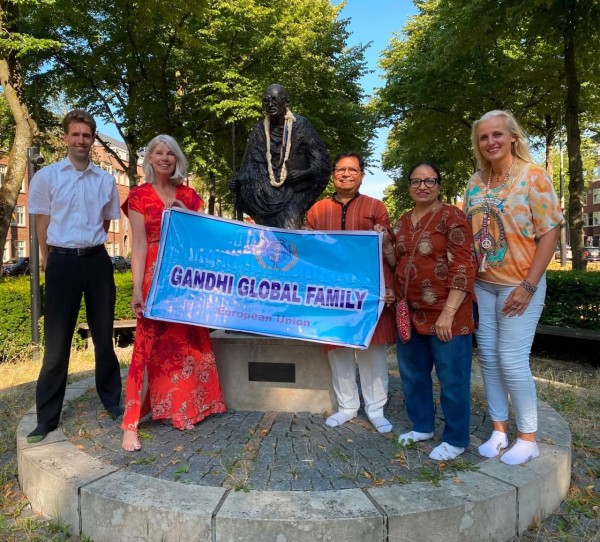
The commemorative ceremony brought together Mr. Ram Mohan Rai, General Secretary of Gandhi Global Family; Mrs. Krishnakanta Rai; Gerbrig Deinum, human rights activist Community Relations Director of the Church of Scientology Amsterdam; Gandhian and human rights advocate and Board member of the Mahatma Ghandu Statue Foundation Patricia Haveman ; Robert Kruijt, Director of Public Affairs at the Church of Scientology Amsterdam, and young Gandhian and ambassador for United for Human Rights; and members of the Indian and Dutch communities.
Participants reflected on the continuing relevance of Gandhi’s principles of truth, non-violence, satyagraha and compassion at a time of armed conflict, social division and growing intolerance. Speakers emphasised that these principles are not confined to a particular country, culture or historical period, but provide a framework for individuals and communities seeking peaceful responses to injustice.
Rai spoke about Gandhi Global Family’s work to advance Gandhian philosophy, interfaith harmony, human rights and international friendship. He described Gandhi as a figure whose moral legacy belongs to the world and whose example places responsibility not only on governments and institutions, but also on individuals.
In remarks subsequently reported by Punjab Kesari, Rai said Gandhi’s life continues to convey a message of truth, moral courage and service to humanity. He urged people to translate admiration for Gandhi into practical conduct, noting that displaying his image is easier than living by his principles.
Deinum reflected on the historical symbolism of a Gandhi statue standing on an avenue bearing the name of Sir Winston Churchill. Churchill was a determined opponent of Gandhi and famously used the dismissive description “half-naked fakir.” The passage of time, Deinum observed, demonstrated that the moral influence of non-violent action could endure beyond imperial power.
“The location carries a powerful message,” Deinum said. “Gandhi’s ideas were ridiculed by some of the most influential figures of his time, yet his commitment to truth and non-violence helped transform history. His statue on Churchilllaan reminds us that ideas rooted in human dignity can outlive prejudice, hostility and political power.”
Rai later described Deinum as a Gandhian friend encountered in the Netherlands, reflecting the personal relationships that can emerge when people from different national, religious and cultural backgrounds work around shared humanitarian principles.
The bronze monument, created by Dutch sculptor Karel Gomes, depicts Gandhi walking with his staff, glasses and sandals. It was unveiled on 2 October 1990, the anniversary of Gandhi’s birth, following an initiative by the Dutch-Indian organisation Triveda. The design surrounding the statue incorporates interwoven natural stone, symbolising the reconciliation of opposites pursued through Gandhi’s non-violent struggle against racism and oppression.
The date of Gandhi’s birth is now observed by the United Nations as the International Day of Non-Violence, recognising the universal significance of his philosophy and his contribution to a culture of peace, tolerance and understanding.
Patricia Haveman praised Mr. and Mrs. Rai for their sustained dedication to peace and humanity. She described their work as a source of hope for communities and proposed an international Gandhian gathering on 2 October in The Hague and at the Amsterdam statue, with online participation enabling peace advocates from other countries to contribute.
The ceremony also opened discussions about future cooperation in India between Gandhi Global Family and United for Human Rights. Areas under consideration include human rights education, peace awareness and youth engagement grounded in the principles of the Universal Declaration of Human Rights and informed by Gandhi’s commitment to non-violent social change.
United for Human Rights produces educational materials explaining the 30 articles of the Universal Declaration in accessible language. The programme is supported by the Church of Scientology and is used by educators, community organisations and human rights advocates of varied religious and cultural backgrounds.
The Church’s support for human rights education is inspired by Scientology founder L. Ron Hubbard, who maintained that spiritual freedom could not be separated from respect for fundamental human rights. He called upon Scientologists to support humanitarian efforts in the field, contributing to the development of educational initiatives intended to make the principles of the Universal Declaration more widely understood.
“The meeting in Amsterdam connected two important traditions of civic responsibility: Gandhi’s insistence that peaceful change begins with personal integrity, and the conviction that human rights must be understood before they can be effectively protected,” said Ivan Arjona, Scientology’s representative to the European Union, the OSCE, the Council of Europe and the United Nations. “European societies are strongest when people of different beliefs and backgrounds cooperate around human dignity, freedom of conscience and non-violence. Giving younger generations practical knowledge of their rights is an investment in peace and democratic resilience.”
The participation of the Church of Scientology Amsterdam continued its involvement in local interfaith and humanitarian activities. The Amsterdam Church, established in the city in 1972, works with community organisations and advocates on initiatives concerning education, human rights and social responsibility.
Robert Kruijt brought a youth perspective to the gathering, linking Gandhian thought with contemporary human rights education. Participants agreed that younger generations should encounter Gandhi not simply as a historical figure, but through discussions about how non-violence, moral courage and respect for others can guide responses to present-day discrimination and conflict.
The programme concluded with a collective pledge to carry forward Gandhi’s message of peace, compassion, non-violence and respect for human rights. The floral tribute served both as remembrance and as an expression of continued cooperation between Indian and Dutch participants committed to translating those principles into community action.
Media Contact
Organization: European Office Church of Scientology for Public Affairs and Human Rights
Contact Person: Ivan Arjona
Website: https://www.scientologyeurope.org
Email: Send Email
Address:Boulevard de Waterloo 103
City: Brussels
State: Brussels
Country:Belgium
Release id:48259
The post Gandhi Tribute in Amsterdam Unites Peace Advocates appeared first on King Newswire. This content is provided by a third-party source.. King Newswire makes no warranties or representations in connection with it. King Newswire is a press release distribution agency and does not endorse or verify the claims made in this release. If you have any complaints or copyright concerns related to this article, please contact the company listed in the ‘Media Contact’ section